 Morphkit
A Python interface to the Morpheus morphological analyser for Ancient Greek
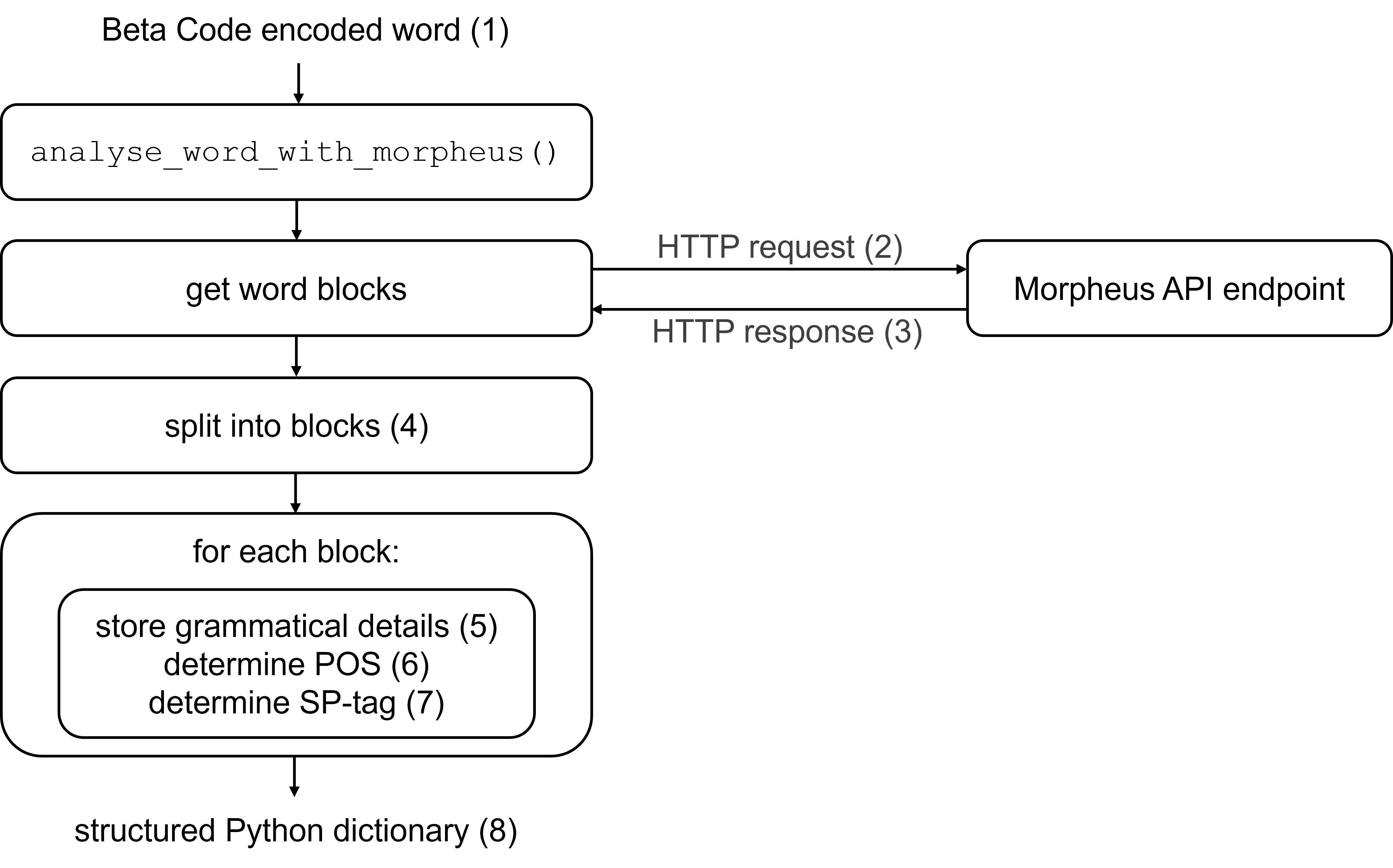
Morphkit is a lightweight Python package that connects research code to a deployed Morpheus service. Given a word form, it retrieves the analyser’s response, separates its analytic blocks, and makes the returned lexical and morphological analyses available as structured Python data. Where Morpheus returns multiple parses, Morphkit retains the alternatives together for inspection and downstream processing.
Explain the numbered stages in Figure 1
- Input dataset: a corpus or dataset supplies the Greek word forms for analysis.
- Pipeline to Morphkit: the Python workflow passes the forms to Morphkit.
- Query: Morphkit sends a request to the configured Morpheus API endpoint.
- Response: Morpheus returns one or more analytic blocks for each queried form.
- Analyses to pipeline: Morphkit parses the response and returns structured analyses to the Python workflow.
- Output dataset: downstream Python code uses the enriched data to create or extend a research dataset, for example in Text-Fabric.
Scope
Morpheus performs the lexical and morphological analysis. Morphkit provides programmatic access to a Morpheus API endpoint and processes its response. The package does not embed the Morpheus engine or independently determine the contextually correct reading of a word.
In the v1.0.0 research setting, Greek analyses may also be augmented with a rule-based part-of-speech classification and a Sandborg–Petersen-style morphological tag aligned with the conventions used in the Nestle1904 Text-Fabric corpus. These are Morphkit annotations derived from Morpheus output and should be distinguished from the analyser’s own fields.
Site contents
- Morpheus — the analyser’s function, output, and role in the workflow
- Workflow and data model — request handling, parsing, representations, annotations, and comparison
- Research context — corpus use, methodological scope, and limitations
- Usage notebook — documented Greek and Latin examples from the project notebook
- Versioned software documentation — installation and API reference